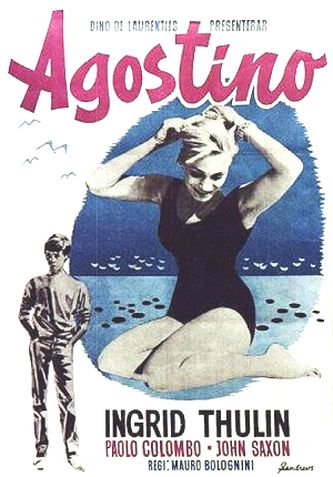
A film earns the label “classic” only when it continues to speak to new generations long after its release. Few pass that test as convincingly as Mauro Bolognini’s Agostino (1962), adapted from Alberto Moravia’s haunting coming-of-age novel, first published in 1944 and released in its definitive Italian edition in 1945.
To celebrate the 80th anniversary of Moravia’s masterpiece, Simon & Schuster has issued a handsome new edition curated by Simone Casini – the perfect occasion for us at theskykid.com to revisit Bolognini’s delicate, sun-drenched, and quietly devastating film.
For me, some of the richest cinematic treasures come from the 1960s and early 1970s, an era when European directors weren’t afraid to stare directly into the awkward, painful heart of adolescence. Agostino stands among the very best of them.
The film opens on the sun-drenched Lido of Venice. A striking widow (Ingrid Thulin, radiant and poised) is holidaying with her thirteen-year-old son, Agostino (Paolo Colombo in his only film role). From the very first frames we feel their intense, almost exclusive bond—mother and son sharing every glance, every laugh, every moment. She is beautiful, wealthy, and alone; the local lifeguards and beach gigolos circle like moths.
Yet until now she has eyes only for Agostino. So when she finally accepts the attention of a handsome young man and begins slipping away for evenings without her son, something inside Agostino quietly shatters. What he experiences isn’t just ordinary jealousy—it’s the sudden, brutal realisation that he is no longer the centre of his mother’s universe.
Bolognini tells the story with exquisite restraint: subtle glances, half-heard conversations, and the occasional stark symbol (a boat drifting away, a closed door) do most of the heavy lifting. What begins as a soft, golden childhood memory slowly sharpens into the unforgiving contours of the adult world. We watch Agostino peel away, layer by layer, from the protected bubble he has always known. Anger, shame, confusion, longing: every raw emotion passes across Paolo Colombo’s face as the boy is pushed—almost against his will—into maturity.
That slow awakening gives the film its quietly morbid undertow. This is not the universal story of just any thirteen-year-old on summer holiday. It is the story of a boy who was raised in an unusually intense, almost exclusive bond with his mother… and who is therefore uniquely vulnerable the moment that bond begins to fracture.

I was astonished by the acting performance of Paolo Colombo, whose facial expressions and attitude contributed significantly to the illustration of his character. The rest of the actors also did an excellent job in portraying their respective characters. In addition to that, the film displays excellent cinematography, which, despite being in black and white, is guaranteed to make quite an impression on its viewers.
I want to express my gratitude to CVMC for providing the DVD of the film Agostino. This review would not have been possible without their support.